I’m not a photographer. Yet my novel In Focus, which I’ve been working on for the last three years, is about photography. A young, fascinating art that I’m slowly beginning to comprehend through books and essays, in exhibition halls and galleries, magazines, the internet. Still, reading about photography is my most trusted guide. The Decisive Moment by Cartier-Bresson and Sebastiao Salgado’s Genesis, collections by Magnum photographers and reference books on composition and “how to”, are helping me progress on this slithering road that bifurcates on every turn, signposted with terminology and opinions, some profound, other puzzling. As most talk about photography as visual language, I keep on drawing parallels with the other two languages I speak — of music and writing.
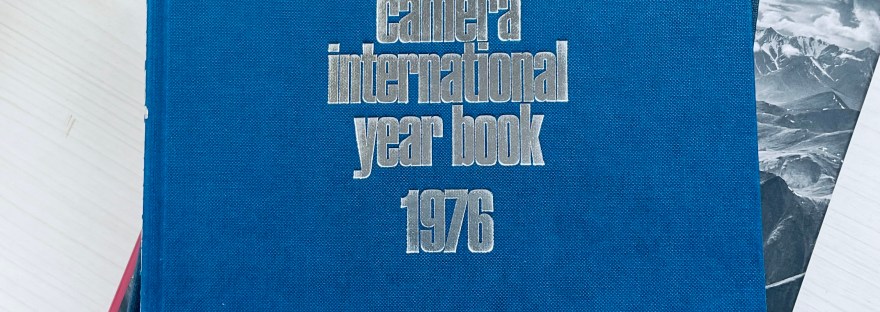
An open letter to a young photographer by Ainslie Ellis is an article I found in the Creative Camera International Year Book, 1976. Hardback blue fabric cover, bold silver letters; the pages are the colour of latte and emit a strong smell of mould and old — old school, old thoughts and theories, even the pace of writing seems aged. But the gems that I found deserve to be warmed up by the polishing cloth of our attention.
“Creation and creative are the two biggest and most sacred words we have to use on this planet. And yet they are trotted out as gilded furnishings for any effort in imagination,” Ellis wrote.
Undoubtedly, we create, daily. The social media platforms provide an outlet for our imagination and we share snapshots, stories, melodies, enjoying a short-lived fame simplified to thumb-likes and hearts on Facebook, Instagram, TikTok. Are we all creatives? In comparison with the context of the term Ellis had used nearly half-a-century ago — maybe not. Yet, when a story of mine is accepted for publication, I feel over the moon. It is exciting, overwhelming for me to think that someone out there would give a precious minute or five of their time to the creation of my imagination. Maybe the connotation of creative is zeitgeist-dependant and it no longer matters what we create, but how do we feel while we’re engulfed by the process?
“You will find, too, that there is a world of difference in seeing and saying in photography. The first is a result of learning to look, to observe, and to understand both why one sees and what one sees.”
I need to draw another parallel here. The advice to every writer is to carry a notebook and record their observations. The notebook is our camera and every page — a negative of the film. Developing the image, though, maybe takes longer in writing. Often a snapshot of an idea I’ve had turns into a story about something else, in the red light of the darkroom and going through the chemical trays of multiple edits. This certainly is the case with my novel, where clarifying cause and effect, characters traits and plot have shifted and reshaped the original image. Have I’ve said what I’ve seen? Would my readers see what I’ve said?
“One well knows, as I’m sure you do, pieces of superb photographic oratory that are quite empty of message, of meaning, of any vision. Sheer excellence of technique, demonstrations of skill: in printing, in use of light, of viewpoint, whatever, should never be scorned. Don’t turn away. Look, analyse the skills employed, even the artifices. Only when you could — if you need to — use any of these skills with confidence can you afford not to take notice, not to learn from them. One day, in one picture, you may need to know how to say what you see.”
God save me from producing a superb oratory that’s empty of meaning!
“You will find, if you are honest with yourself (and this is essential to becoming a creative person) that the problems that slow you up, all the many checks to that progress you have dreamt of in working fully and freely, lie entirely inside you. They are never problems of technique, never attributable to one’s equipment. Exchanging your camera, your emulsion, or your model can do nothing to help except act as a marginal stimulus. The equipment you need to work on is yourself. Your Self. “
So, there’s hope. I won’t hurry to get myself a better laptop, writing software and spellchecking programme. While I search for My Self, taking notice of techniques and craft elements of writing through photography, my imaginative musings might lead me to that sacred place where Creation is etched above the entrance in bold silver letters.
 Rostislava Pankova-Karadjova